```markdown
Unearthing Mark Fidrych's Net Worth: The Bird's Financial Legacy, Revealed
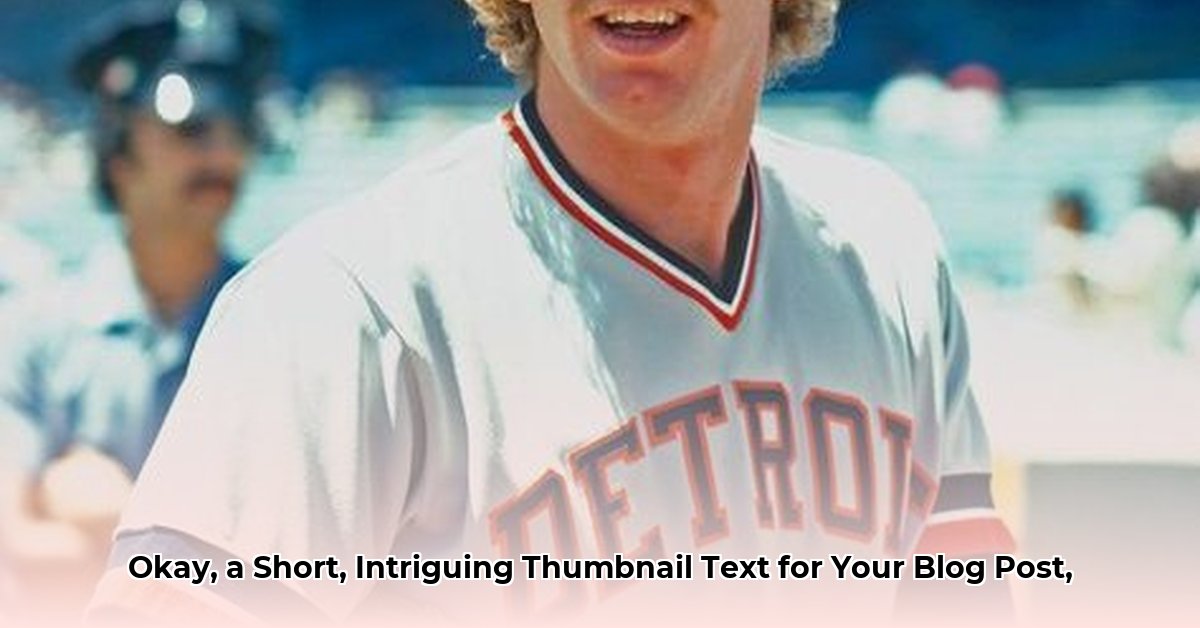
Mark "The Bird" Fidrych soared into baseball stardom in 1976, captivating fans with his eccentric behavior and remarkable pitching prowess. Beloved by many, his time in the limelight was sadly short-lived. This article delves into the financial aspects of his career, examining his earnings during his peak, the impact of his career-ending injury, his post-baseball endeavors, and his estimated net worth at the time of his passing. It's a poignant exploration of the financial realities faced by a baseball icon whose brilliant career was prematurely curtailed.
Mark Fidrych Net Worth: Unearthing The Bird's Financial Legacy
Mark "The Bird" Fidrych, famous for his engaging on-field conversations with the baseball and electrifying performances, captured the hearts of baseball enthusiasts in the mid-1970s. To understand baseball finances better, see other player's wealth. Beyond his charisma and the widespread "Birdmania," lies a compelling question: What was Mark Fidrych net worth when he tragically passed away? Let's explore the real financial implications of early retirement due to injuries.
His financial narrative is intricately linked to his meteoric rise and the unfortunate injury that abruptly ended his career. It's a story of unrealized potential, set against the backdrop of baseball economics from a bygone era. Determining his financial legacy necessitates thorough investigation, combining insights from his playing career with the realities of his life after baseball.
The Roar of the Crowd and the Rookie's Paycheck
The year was 1976, and "The Bird" took flight, earning the title of Rookie of the Year, an honor that brought fame and recognition. However, even promising young stars didn't command the astronomical salaries prevalent today. So, how did Fidrych's earnings stack up against his contemporaries? Obtaining precise figures proves challenging, but we can examine contracts of players in comparable positions during that era, with similar experience and skill. This helps to build a financial model for baseball rookies.
Did "Birdmania" translate into lucrative endorsements? It's plausible. His unique personality was a marketer's dream, opening doors for commercials and merchandise. However, concrete evidence of any major endorsement deals remains surprisingly elusive. It's possible that deals were smaller, localized, or simply not well-documented. It's also crucial to consider that the endorsement landscape differed vastly in the 1970s compared to the multi-billion dollar industry it is now, impacting sports endorsement revenue.
When a Wing is Clipped: The Impact of Injury
The baseball gods can be unforgiving, a reality Fidrych knew firsthand. A rotator cuff injury tragically derailed his career, significantly diminishing his earning potential. It's natural to ponder: How much more could he have earned if he'd pitched for another five or ten years? A healthy, extended career could have led to larger contracts, more endorsements, and a secure financial future. The injury not only took him off the mound but also closed doors to opportunities he might have had, which greatly emphasizes "the financial consequences of sports injuries".
Back to Earth: Life After the Diamond
Following his baseball career, Fidrych returned to his roots in Massachusetts, working as a contractor, driving a truck, and performing odd jobs. This starkly contrasted the roaring stadiums and flashing cameras. While this provided a steady income, it likely didn't approach what he could have earned in the major leagues. His post-baseball life reflects his humility and strong work ethic, but also underscores the financial challenges many athletes face when their careers are cut short. He was also actively involved in youth baseball, imparting his wisdom and passion for the game to younger generations, showcasing "life skills learned from baseball".
Piecing Together the Puzzle: Approximating Mark Fidrych's Net Worth
So, how do we arrive at an estimated Mark Fidrych net worth? It's similar to assembling a jigsaw puzzle with missing pieces. We must consider his baseball salary (in the context of the era), any endorsements (though seemingly minimal), and his earnings as a contractor. Given the limited publicly available information, obtaining an exact figure is nearly impossible. Any estimate will involve speculation and educated guesswork; it's all about the "estimation of personal wealth".
Here’s a table summarizing the factors:
| Income Source | Estimated Value | Notes |
|---|---|---|
| MLB Salary | Relatively modest compared to today's standards, but competitive for the late 1970s. | Need to account for inflation to understand its true value. Examining contracts of similar players from that time period would give a better range. This involves understanding "historical baseball salaries". |
| Endorsements | Likely minimal. | While "Birdmania" was a phenomenon, it's unclear whether it translated into significant endorsement deals. The landscape of endorsements was very different in that era. |
| Post-Baseball Income | Steady, but modest. | Working as a contractor provided a stable income, but likely not comparable to potential MLB earnings. This requires "income evaluation for contractors". |
| Assets & Investments | Unknown. | Without access to private records, it's impossible to know what assets or investments Fidrych may have had. This refers to private "asset assessment". |
Several factors make pinpointing Mark Fidrych net worth a real challenge:
- Privacy: Fidrych lived a relatively private life after his baseball career, meaning limited public insight into his financial affairs and very restricted access to his financial records. It's an issue of "celebrity financial privacy".
- Inflation: The value of money fluctuates over time. To get an accurate picture, we'd need to adjust 1970s dollars to their equivalent value today, further complicating calculations. Calculating "historic inflation impact" is essential.
- Unknowns: Did he have investments? Did he own property? Without access to his private records, these questions remain unanswered, highlighting the "unknowns in wealth estimation".
The Bottom of the Ninth: Reflecting on a Legacy
Fidrych's untimely death in 2009 was a loss for the baseball world and a sad end to a life marked by hard work and a genuine love for the game. While we may never know the precise figure of his financial situation, examining his life allows us to appreciate the story behind the numbers. It is a "legacy assessment of athletes".
While putting an exact number on Mark Fidrych net worth is difficult, it's safe to say that his legacy extends far beyond dollars and cents. He brought joy to countless fans, reminded us of the simple pleasures of the game, and left an indelible mark on baseball history. His story reminds us that true wealth isn't always measured in money, but in the impact we have on others. His "lasting impact on baseball" is his true wealth.
What Caused Mark Fidrych's Injury?
Key Takeaways:
- Mark Fidrych, known as "The Bird," captivated baseball in 1976 with his unique antics and exceptional performance, earning him Rookie of the Year. This captures the essence of his "rise to fame".
- A knee injury sustained during spring training in 1977, followed by a shoulder injury, tragically cut short his promising career. "Injuries ending careers" is a tragic theme in sports.
- The shoulder injury's exact cause is debated, ranging from a "tired arm" diagnosis to a potential torn rotator cuff. This brings to light "misdiagnosis in sports medicine".
- Some believe the initial knee injury altered his pitching motion, leading to undue stress and the subsequent shoulder injury. The "domino effect of sports injuries" is a significant factor.
The Bird Takes Flight
Mark Fidrych wasn't just a baseball player; he was a phenomenon. "The Bird," as fans affectionately called him, brought unmatched energy to the game. His quirky habits on the mound—talking to the ball, manicuring the mound, celebrating every out—reinvigorated the Detroit Tigers and drew massive crowds. Consider him baseball's own rock star, or "baseball's performance icons".
More than just a showman, Fidrych had the stats to back it up. In 1976, he led the American League with a stellar 2.34 ERA and snagged the Rookie of the Year award with a 19-9 record. His games were more than matches; they were an event, a true "peak performance in baseball".
The Injury and Decline
But as with many shooting stars, Fidrych's brilliance was fleeting. What caused Mark Fidrych's injury that ultimately derailed his career? It began with what seemed like a minor setback: a knee injury during spring training in 1977 when shagging fly balls. This seemingly innocuous incident would set off a chain of unfortunate events. It emphasizes the "unforeseen consequences of sports injuries".
Upon his return to the mound, Fidrych soon began experiencing shoulder pain. The initial diagnosis was vague, described as tendinitis or simply a "tired arm." We now understand, however, that he likely suffered a torn rotator cuff. Did the knee injury alter his pitching motion,